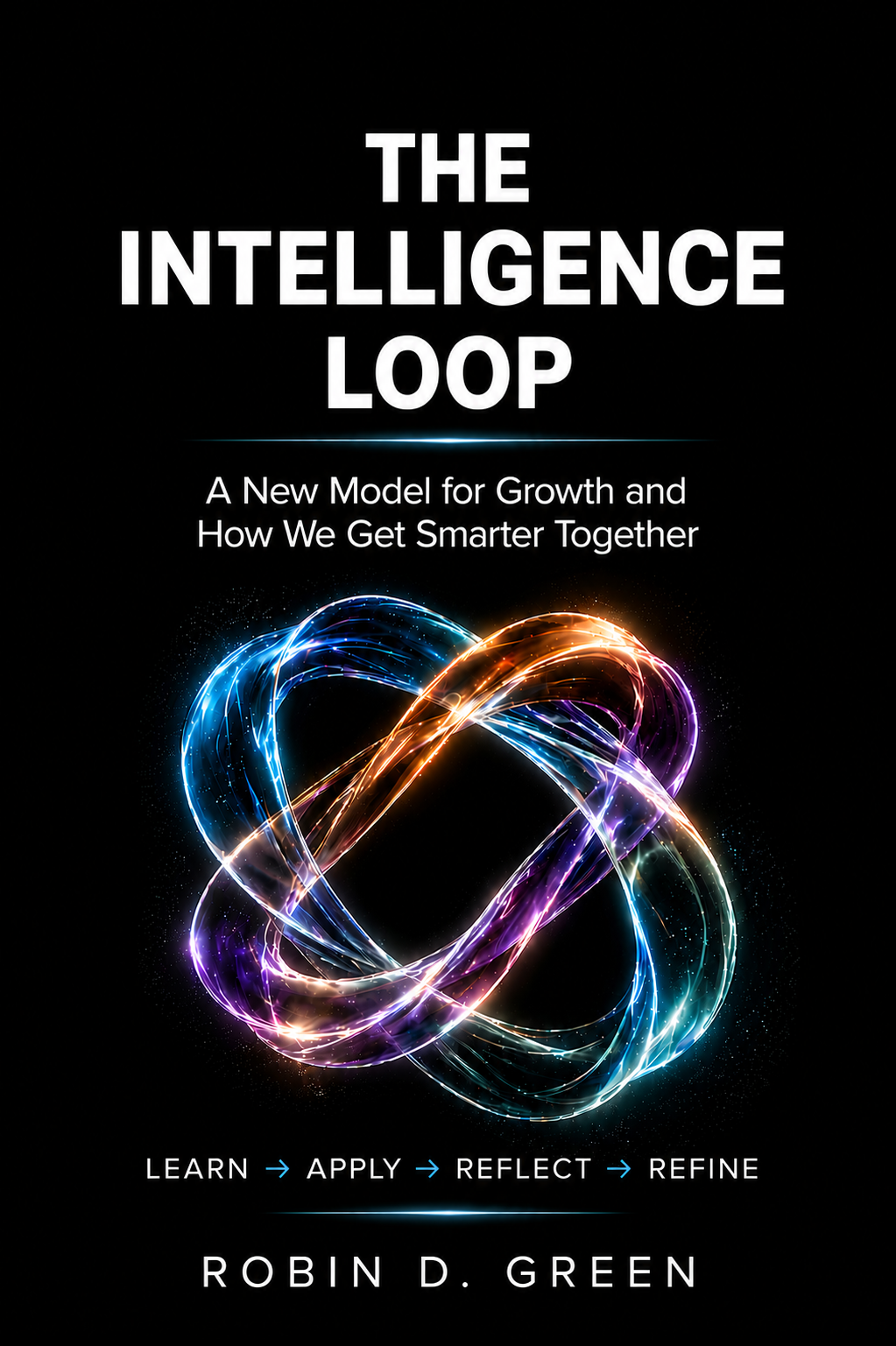
The Intelligence Loop
A New Model for Growth and How We Get Smarter Together
Artificial intelligence is not replacing humanity. It is redefining it.
In The Intelligence Loop, Robin Green argues that the future belongs not to the most powerful machines, but to the most collaborative humans. Drawing on a career spent working with Fortune 100 enterprises deploying technology solutions to drive business value, Green offers something rare in the AI conversation: clarity, grounded in actual practice.
Structured across eight chapters, the book moves from the technological transformation of markets through the redefinition of work, creativity, leadership, and ethics, culminating in a call to co-create a future built on collaboration rather than competition.
This is not a book about algorithms. It is a book about us.
What’s Inside
- Chapter 1: The Great Shift: Why AI Changed the Rules of Growth
- Chapter 2: From Automation to Augmentation
- Chapter 3: The Human Edge in an Intelligent World
- Chapter 4: The New Architecture of Work
- Chapter 5: Redefining Value in the Age of Intelligence
- Chapter 6: The Ethics of Intelligence
- Chapter 7: The New Covenant of Work
- Chapter 8: The Age of Human Greatness
Inside The Intelligence Loop
Three passages that capture what this book is about.
From Chapter 3 — The Human Edge in an Intelligent World
What Data Can’t Feel
As AI absorbs more analytical and cognitive work, the frontier of competitive advantage shifts to what machines can’t replicate: empathy, humor, a sense of belonging, the ability to make someone feel genuinely seen.
In an environment where functional differences between products narrow quickly, emotional differences widen. Empathy has become a hinge on which brand loyalty turns. Consumers are aware when automation is present — chatbots, recommendation engines, dynamic pricing — but awareness doesn’t produce resistance. What produces resistance is indifference.
AI can measure sentiment. Only humans can feel it. AI can generate copy. Only humans can make it mean something. The tools keep getting better. The human premium keeps growing.
From Chapter 6 — The Ethics of Intelligence
The Doctor Who Overruled the Machine
A medical AI at Johns Hopkins Hospital once flagged a patient as low priority for an emergency scan based on risk algorithms. The data was correct by every measure the algorithm was given. A physician looked at the same patient and felt something the data had not captured.
He ordered the scan anyway. The patient had a life-threatening aneurysm.
The doctor later said: “AI is brilliant at patterns. But sometimes, you need a pulse.”
That instinct — the willingness to see beyond the data to the person behind it — is not a limitation of AI. It is the irreducible core of what humans bring to every room they walk into.
From Chapter 8 — The Age of Human Greatness
What We Are Building Toward
We are standing at the edge of a transformation as profound as the Industrial Revolution — but this time, the raw material isn’t steel or silicon. It’s soul.
The future won’t belong to the most efficient or even the most intelligent. It will belong to those who remain most human — who engineer not only intelligence, but integrity. Who measure success not only by market share, but by the lives they elevate.
Value, in its truest form, isn’t a number. It’s a narrative — one that says we made the world a little wiser, a little kinder, a little more whole.
There are eight chapters. These are three passages.
The full argument — grounded in real commercial experience — is in the book.
Or start with Chapter 1 free →
Who This Book Is For
Senior Business Leaders
CMOs, CDOs, CEOs, and senior executives navigating AI adoption decisions inside large organizations. If you have budget, mandate, and the pressure to get this right, this book was written for you.
Practitioners and Professionals
Managers and professionals who are executing AI transformation in real time — navigating teams that feel threatened by the same tools they are being told will make their work better.
Thoughtful Readers
Anyone asking the question no algorithm can answer: what remains irreplaceable about human work? If you are looking for clarity over hype, this book offers it.
In the Press
Mensa Bulletin — June 2026
The Intelligence Test: What Artificial Intelligence Reveals About Us
Robin Green’s article in the Mensa Bulletin explores what AI reveals about human creativity, conscience, and the choices that still belong to us. A summary of the book’s central argument, published to the Mensa membership.
Read and Download →